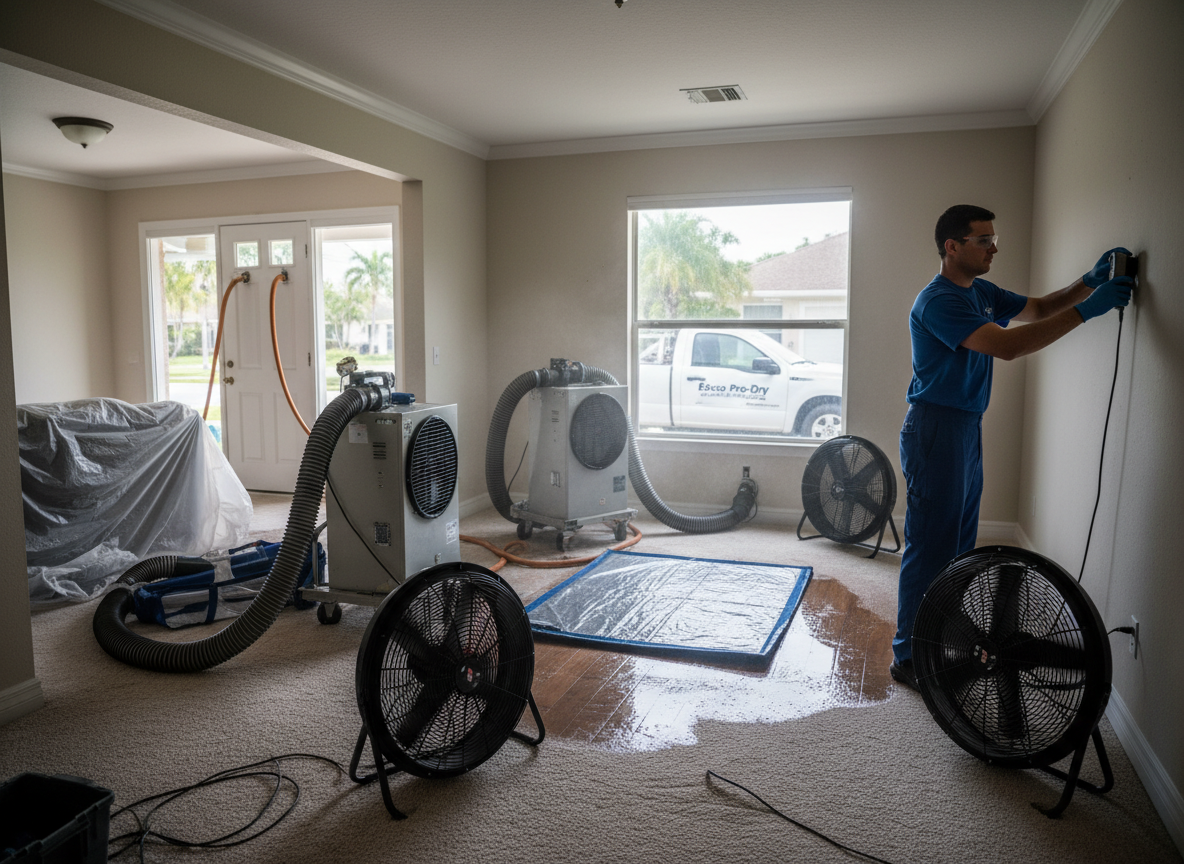
Boca Raton’s tropical rainforest climate keeps relative humidity high for months, so structural drying after leaks or flooding must account for slower evaporation in older stucco and concrete-block homes found in Royal Palm Yacht & Country Club and Boca Raton Hills. Moisture travels along lath-and-plaster walls and into tongue-and-groove subfloors common in pre-1980 construction, requiring targeted airflow behind baseboards and under cabinets rather than surface fans alone. Without daily meter checks, hidden pockets remain and later trigger mold claims with insurers.
Downtown Boca Raton and University Park properties often sit on slightly elevated lots, yet storm surge or plumbing failures still push water into slab-on-grade foundations and under tile. Desiccant dehumidifiers sized for 150-plus pints per day pull moisture from deep within drywall and insulation while high-velocity air movers are angled into wall cavities to avoid blowing humid outdoor air across wet materials. Technicians must watch for delamination of engineered hardwood popular in Mizner Park condos, because rapid drying can cup boards if relative humidity inside the cavity is not lowered gradually.
Nearby coastal neighborhoods like Boca Raton Beach experience salt-laden air that accelerates corrosion on metal fasteners once moisture lingers. Structural drying crews therefore isolate zones with plastic sheeting and run equipment past normal residential hours when possible, logging moisture readings at multiple depths until equilibrium with ambient conditions is reached. Final verification includes thermal imaging and pin meters on both sides of every affected wall to satisfy insurance adjusters and local building departments before any reconstruction begins.
Technician insight
In Boca Raton the thing that catches most people out with structural drying is how quickly high summer humidity re-wets drywall once equipment is pulled too soon, especially in the older concrete-block homes around Mizner Park where moisture hides behind tile backer boards.
Hidden Moisture After Leak in University Park
A homeowner near Florida Atlantic University reported a slow pipe leak that soaked baseboards. Meters showed elevated readings behind drywall and under engineered flooring. Targeted dehumidifiers and air movers ran for six days with daily checks until all cavities reached ambient levels. Final imaging confirmed no residual moisture remained.
Structural Drying Services We Offer
✓Moisture Mapping Surveys
Grid-based meter readings and thermal scans locate hidden water in walls and subfloors of Boca Raton homes before drying begins.
✓Industrial Dehumidifier Placement
High-capacity desiccant units sized for Palm Beach County humidity pull moisture from cavities in Mizner Park and Royal Palm properties.
✓Directed Air Circulation
Air movers positioned to force dry air behind baseboards and into wall cavities common in older University Park construction.
✓Subfloor Drying Systems
Perforated mats and negative-pressure setups extract water from hardwood and tile underlayment without demolition in Downtown Boca Raton homes.
✓Daily Moisture Monitoring
Technicians record readings at set intervals until materials reach equilibrium with local ambient humidity levels.
✓Post-Drying Verification
Final thermal and pin-meter checks confirm all structural components are dry before reconstruction in Boca Raton Beach residences.
Structural Drying Cost in Boca Raton, FL
| Service | Typical Range | What Affects It |
|---|---|---|
| Single-room structural drying | $900–$1,800 | Varies with wall cavity access and daily humidity levels |
| Whole-floor drying | $2,200–$4,500 | Higher in older stucco homes with multiple subfloor layers |
| Crawl-space or slab-edge drying | $1,400–$2,900 | Depends on access and salt-air exposure near the beach |
| Daily equipment rental extension | $250–$450 per day | Added when readings remain elevated after initial estimate |
Ranges are typical for Boca Raton, FL and confirmed with an exact written quote before any work starts.
How it works
- 1
Site Assessment
Technicians map moisture across affected rooms using meters and infrared cameras while noting construction type and local humidity.
- 2
Equipment Setup
Dehumidifiers and air movers are placed and isolated with containment to target wall cavities and subfloors without disturbing unaffected areas.
- 3
Ongoing Monitoring
Daily readings guide adjustments to airflow and dehumidification until all materials stabilize at acceptable moisture content.
- 4
Clearance Testing
Final verification with multiple meter types confirms the structure is dry and ready for repairs or insurance documentation.
Pricing
Project pricing reflects square footage, depth of saturation, and number of days required in Boca Raton’s humid conditions; ranges below are typical for local homes.